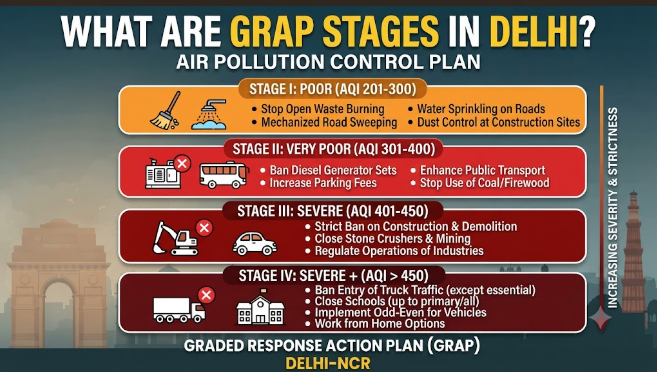
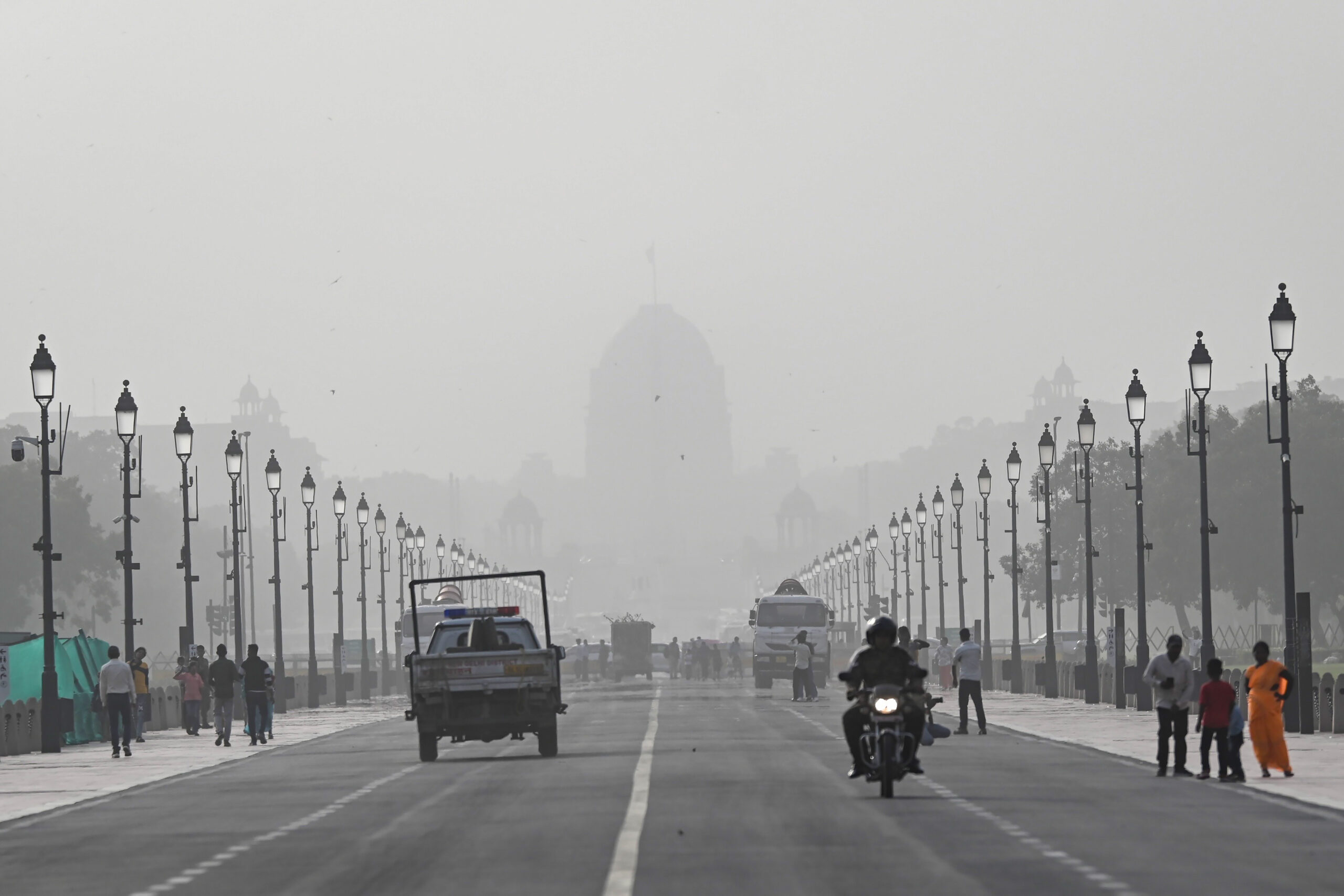
GRAP stages decide which anti-pollution rules apply in Delhi and the NCR. Right now, Delhi is under GRAP Stage 1. Below, we explain every stage in simple words, so you know what changes for your car, your commute and your children’s school.
Current status: The Commission for Air Quality Management (CAQM) brought in GRAP Stage 1 on October 21, 2026, after Delhi’s average AQI crossed 240. Then, on October 28, Delhi woke up to an AQI of 228. Some monitoring stations crossed 300.
Contents
What are GRAP stages in Delhi?
GRAP stands for Graded Response Action Plan. It is an emergency plan for Delhi and the National Capital Region (NCR). The Environment Ministry first notified it in 2017. Today, the CAQM runs it under the CAQM Act, 2021.
The plan has four stages. Each stage matches a band of the Air Quality Index (AQI). When experts expect the AQI to cross a band, CAQM’s GRAP sub-committee moves Delhi to the next stage. Also, the rules of lower stages stay in place at every higher stage.
Why does Delhi need this every winter? Because several problems hit at once. Farmers burn crop stubble in nearby states. Meanwhile, vehicles and construction sites add smoke and dust. Cold, still air then traps all of it close to the ground.
GRAP stages in Delhi at a glance
The table below shows which AQI level triggers each stage.
Stage
AQI level
Air quality
Stage 1
201–300
Poor
Stage 2
301–400
Very Poor
Stage 3
401–450
Severe
Stage 4
Above 450
Severe Plus
[IMAGE]
GRAP Stage 1 in Delhi: what you cannot do
GRAP Stage 1 starts when Delhi’s AQI enters the “poor” band. It brings these rules:
No open burning of garbage, leaves or other waste.
No coal or firewood in tandoors at restaurants and dhabas.
Diesel generators cannot serve as a regular power source. However, essential services get exemptions.
Construction sites must control dust. For example, builders must cover materials, carry debris in covered trucks and sprinkle water. Sites of 500 square metres or more also need registration and monitoring.
Buses from other states can enter only if they run on electricity or CNG, or meet BS-VI diesel norms.
Traffic police check Pollution Under Control (PUC) certificates strictly. They also act against overage petrol and diesel vehicles.
GRAP Stage 2 in Delhi: extra steps
When the AQI crosses 300, the air turns “very poor” and GRAP Stage 2 begins in Delhi. In addition to all Stage 1 rules, Stage 2 usually brings daily mechanical sweeping and water sprinkling on major roads. It also brings higher parking fees to keep private cars off the road, plus more bus and Metro trips. For the full list, check the latest order on the CAQM website.
GRAP Stage 3 in Delhi: older cars and construction
GRAP Stage 3 begins when Delhi’s AQI enters the “severe” band. As a result, the rules get much stricter:
You cannot drive BS-III petrol or BS-IV diesel cars in Delhi, Gurugram, Faridabad, Ghaziabad and Gautam Buddh Nagar (Noida). From 2026, the same rule also covers Sonipat.
Older diesel goods vehicles (BS-IV or below) from outside Delhi cannot enter the city. Moreover, the 2026 rules removed the exemption for light and medium goods vehicles that carry essential goods.
Most construction and demolition work stops.
The government asks offices to let staff work from home.
State governments may also move younger students to hybrid or online classes.
GRAP Stage 4 in Delhi: trucks, schools and offices
GRAP Stage 4 is the last stage. It starts when Delhi’s AQI goes above 450. At this point:
Non-essential trucks cannot enter Delhi. Only trucks that carry essential goods, run on CNG, LNG or electricity, or meet BS-VI norms can enter.
From 2026, BS-IV and older trucks lose their essential-goods exemption.
Schools stop in-person classes for most students. However, Classes 10 and 12 may continue.
The Delhi and NCR governments can decide to let 50% of staff in public, private and municipal offices work from home.
Finally, authorities can close colleges, stop non-essential business and bring back odd-even rules for cars.
What changed in GRAP in 2026?
In September 2026, the CAQM approved a revised GRAP schedule. Here are the main changes:
Rules on diesel generators and older buses (BS-IV or below) now start at Stage 1 instead of Stage 2.
Sonipat joined the NCR districts where older cars face Stage 3 curbs.
Older diesel goods vehicles lost their essential-goods exemption at Stages 3 and 4.
Dust checks now also cover eligible projects outside city limits, such as industrial areas and highway corridors.
So, GRAP now acts earlier and covers a wider area than before.
How to check Delhi’s AQI today
You can track live AQI on the CPCB’s SAMEER app or on the CPCB website. Both show readings from every station in Delhi and the NCR. In general, AQI is worst early in the morning and late at night, because the air barely moves then.
First, skip outdoor exercise when the AQI is poor, especially early in the morning.
Next, wear a well-fitting N95 mask outdoors. Cloth and surgical masks do little against fine particles.
Also, keep windows closed during peak pollution hours.
Finally, children, older people and anyone with breathing or heart problems should take extra care and follow their doctor’s advice.
Frequently asked questions
What is GRAP Stage 1 in Delhi?
It is the first level of anti-pollution rules. It applies when Delhi’s AQI stays between 201 and 300. Under it, you cannot burn waste in the open, and restaurants cannot use coal or firewood in tandoors.
Can I drive my BS-IV diesel car in Delhi?
Yes, under Stages 1 and 2. However, from Stage 3 onwards, you cannot drive BS-IV diesel or BS-III petrol cars in Delhi and nearby NCR districts.
Will schools close under GRAP?
Under Stage 4, schools stop in-person classes for most students, except Classes 10 and 12. At Stage 3, states may shift younger students to hybrid classes.
Who decides the GRAP stage?
The GRAP sub-committee of the CAQM decides. It looks at current AQI readings and the forecast for the coming days.
We update this article whenever the GRAP stage changes in Delhi.