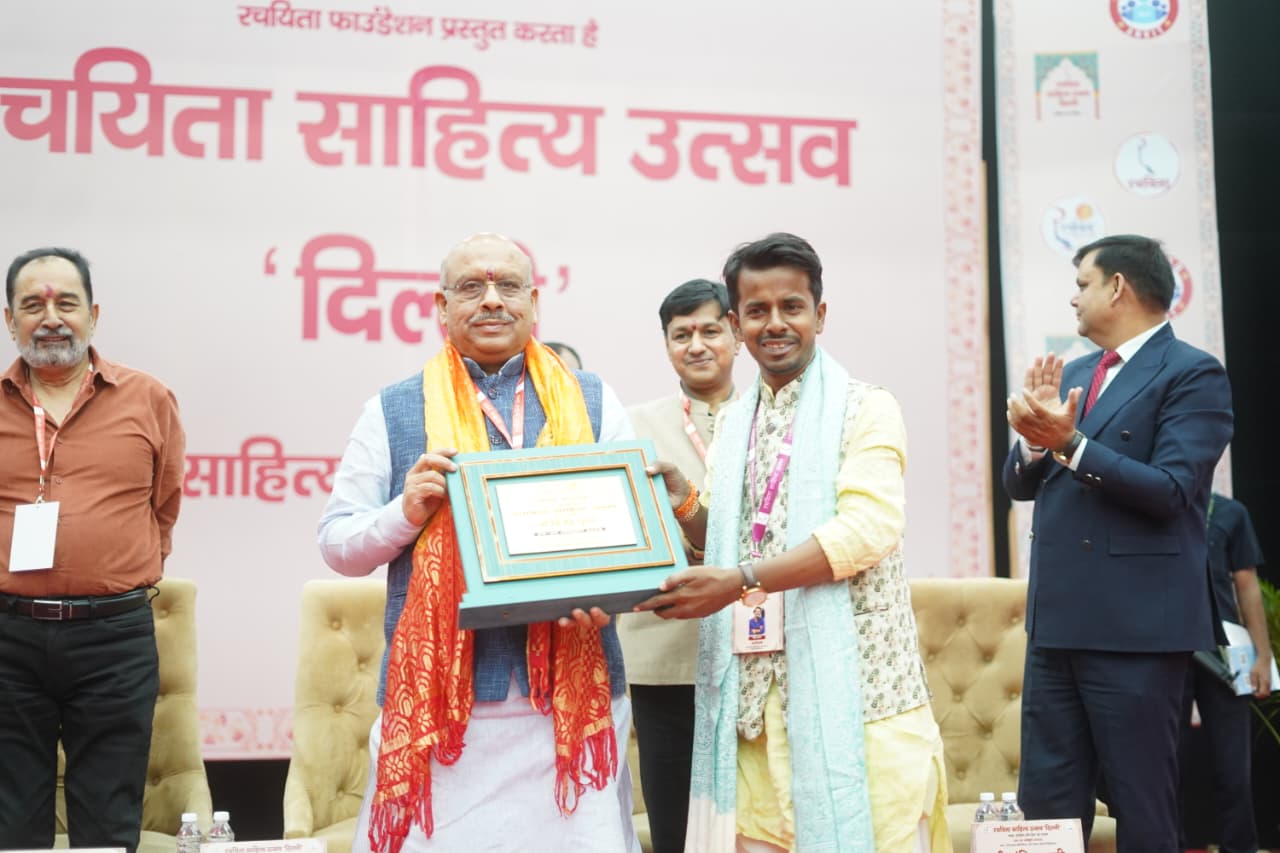
New Delhi, 29 October 2026“Language is the soul of a nation, and literature gives permanence to its ideas and values. The identity of a country is shaped not merely by its geographical boundaries, but by its language, literature and cultural heritage,” said the Hon’ble Speaker of the Delhi Legislative Assembly, Shri Vijender Gupta, while addressing the inaugural session of the Rachayita Literary Festival 2026 as the Chief Guest at Delhi University today. Speaking on the theme “Language, Literature and the Nation” (भाषा, साहित्य और देश), he emphasised that language, literature and national identity are deeply interconnected and that preserving linguistic heritage is essential to safeguarding the civilisational legacy of India.
Addressing the gathering, Shri Gupta said that language is far more than a medium of communication; it embodies a society’s consciousness, emotions, traditions and collective memory. Citing the contributions of literary figures such as Kabir, Surdas, Mirabai, Tulsidas and Goswami Tulsidas, he observed that India’s literary traditions have enriched regional languages while weaving the country into a shared cultural fabric. He noted that literature has the power to transcend geographical and social boundaries, preserve collective wisdom and express the joys, struggles and aspirations of generations.
Highlighting the historical significance of language and literature, the Speaker said that attempts to weaken a nation’s civilisation often begin with attacks on its linguistic and literary traditions. Referring to India’s experience under foreign rule, he recalled how indigenous languages and literary works sustained the country’s cultural consciousness despite prolonged political domination. He also cited examples from Japan, Germany, France and Israel to demonstrate how language and literature can strengthen national identity, revive cultural confidence and contribute to a nation’s intellectual and social development.
Shri Gupta invoked the thoughts of Bharatendu Harishchandra and Mahatma Gandhi to underline the importance of Indian languages in national awakening and education. Referring to Gandhi’s views on mother-tongue education, he stressed that children learn and understand concepts more effectively when taught in their own language. He also highlighted the contribution of Rabindranath Tagore, Bankim Chandra Chattopadhyay and Subramania Bharati, whose literary works inspired national consciousness and strengthened the spirit of freedom. Emphasising that linguistic diversity is a source of strength, he said that Indian languages must receive due respect and encouragement without diminishing the importance of learning other languages.
The Speaker further highlighted the relevance of language and literature in contemporary India, particularly in education, research and public administration. Referring to the Delhi Legislative Assembly’s efforts to promote Hindi in its official functioning, he said that the Assembly has been expanding the use of Hindi in correspondence and other activities. He also spoke about the potential of the Government of India’s Bhashini platform to bridge linguistic barriers through translation, transcription and voice-based technologies, enabling people to access information and communicate across Indian languages. He encouraged young people to read, write and create in their mother tongues, observing that every literary contribution strengthens the cultural foundations of the nation.
Concluding his address, Shri Gupta commended the Rachayita Literary Festival for providing a platform for young researchers, writers and students to engage with India’s rich literary heritage through discussions, poetry, seminars and creative competitions. He expressed his appreciation to the organisers and acknowledged the efforts of the Rachayita institution in nurturing literary activities and promoting Indian languages. Calling upon the youth to regard their mother tongue not merely as a subject of study but as a living expression of their identity and heritage, he said that a nation which respects its languages and enriches its literature strengthens its cultural confidence and earns a distinguished place in the world. The two-day festival, being held on 29 and 30 October 2026, brings together discussions on language, literature, national identity and cultural heritage.