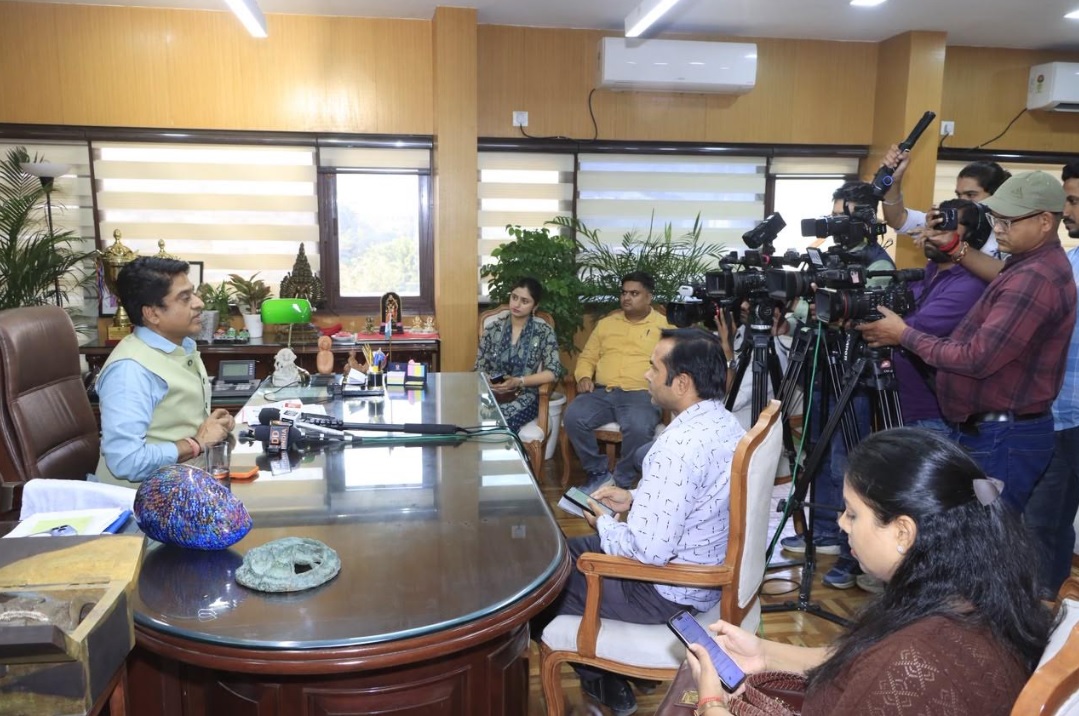
New Delhi: In line with the vision of Hon’ble Prime Minister Shri Narendra Modi Ji for a Clean, Green and Developed India, the New Delhi Municipal Council (NDMC) is undertaking comprehensive measures to control air pollution, improve road cleanliness, expand green spaces and protect the environment across the New Delhi area, it is informed by NDMC Vice-Chairperson Shri Kuljeet Singh Chahal during a press conference held today at Palika Kendra headquarters.
Shri Kuljeet Singh Chahal stated that the NDMC area covers approximately 42.7 square kilometres and that the Council maintains nearly 416 kilometres of roads. The area houses several prestigious buildings, important Central Government offices, prominent hotels and embassies of various countries. Maintaining cleanliness, controlling road dust and reducing air pollution in this important area are among the Council’s key priorities. Accordingly, modern machinery and technology are being deployed to strengthen road cleaning, dust control and environmental protection measures.
*Mechanical Road Sweeping and Dust Control*
Shri Chahal stated that NDMC currently has 11 large mechanical road sweeping machines, 4 small sweeping machines, 4 ride-on scrubbers and 20 litter pickers. Plans are also underway to procure or deploy 4 additional large and 4 medium-sized mechanical road sweeping machines, along with 4 leaf pickers, to further strengthen the cleaning system. He directed officials to prioritise night-time cleaning wherever required so that dust levels on roads can be reduced by the morning.
*Mist Spray Systems to Be Installed on 1,200 Electric Poles*
Shri Chahal stated that mist spray systems are being installed on electric poles to help reduce air pollution. During the financial year 2026–27, NDMC aims to install these systems on approximately 1,200 electric poles, covering around 26.69 kilometres of roads.
He informed that mist spray systems are already operational at six locations, including Man Singh Road, Shahjahan Road, Bhagwan Das Road, Tilak Marg, Subramania Bharati Marg and Dr. Zakir Hussain Marg. The systems are targeted to become operational within a week on six additional roads: Aurobindo Marg, Prithviraj Road, Dr. A.P.J. Abdul Kalam Road, Motilal Nehru Marg, Copernicus Marg and Barakhamba Road.
In addition, NDMC plans to operationalise mist spray systems by November 2026 on the following roads: Mother Teresa Crescent, Sheikh Mujibur Rahman Road, Shankar Road, Mandir Marg, Feroz Shah Road, Sikandra Road, R.K. Ashram Marg, Peshwa Road, Shaheed Bhagat Singh Road, Ashoka Road, B.K.S. Marg and Bhai Veer Singh Marg.
An additional installation on Sher Shah Suri Marg is targeted for December 2026.
The systems have also been made operational in the first phase on Lodhi Road, Shanti Path and Africa Avenue.
*Anti-Smog Guns and Monitoring of Construction Sites* Shri Chahal stated that 12 truck-mounted or mobile anti-smog guns are being deployed in the NDMC area to control dust and pollution.
In addition, anti-smog guns have been installed in 10 prominent private buildings, including The Leela Hotel, Hotel The Park, Shangri-La Hotel, ITC Maurya, The Taj Mahal Hotel, Taj Mansingh Hotel, The Oberoi, The Lalit Hotel, Chanakya Mall and the DLF Building.
Anti-smog guns have also been installed at NDMC buildings, including Yashwant Place Building, Chanakya Bhawan, Palika Bhawan, Skill Development Centre, Moti Bagh, Lok Nayak Bhawan, Pragati Bhawan, Chandralok Building, Mohan Singh Place, Mayur Bhawan and Palika Amrit Kaal Niwas.
Furthermore, 115 anti-smog guns have been installed at construction and demolition sites to help control dust emissions.
*Road Washing and Water Sprinkling*
Shri Kuljeet Singh Chahal stated that NDMC currently has 13 pressure jetting machines and 18 water tankers for road washing and dust control, of which 10 tankers are equipped with sprinkler systems. The tankers have capacities ranging from 5,000 to 10,000 litres. Depending on operational requirements, these vehicles cover approximately 20–25 kilometres daily and make two to three trips.
He further stated that, to strengthen pollution-control efforts, the number of pressure jetting machines will be increased from 13 to 20 in the future. This expansion will help improve regular road washing and further strengthen dust-control measures across the NDMC area.
*NDMC’s Green Cover and Plantation Drive*
Expressing pride in NDMC’s environmental achievements, Shri Kuljeet Singh Chahal stated that approximately 64.48% of the NDMC area is under green cover, reflecting the Council’s sustained efforts towards environmental conservation and green development.
He informed that approximately 30 lakh plants and shrubs were planted during 2025–26. For 2026–27, the Council has set a target of planting 5,100 trees and 5 lakh shrubs. So far, 1,749 trees and 3,73,587 shrubs have been planted, representing approximately 74.31% progress towards the stated target. Shri Chahal directed the concerned officials to complete the plantation drive within the stipulated timeline and ensure proper care and protection of the plants.
*Roadside Greenery and Maintenance of Footpaths*
Shri Kuljeet Singh Chahal stated that greenery has been developed along approximately 19.957 kilometres of central verges and roadside stretches in the NDMC area. Efforts are also being made to eliminate unpaved road surfaces, while roads, footpaths and other public spaces are regularly maintained and repaired.
He directed officials to promptly address potholes, damaged footpaths and other issues that could contribute to dust generation or cause inconvenience to citizens.
Irrigation with Treated Water and Smart Irrigation
Shri Chahal stated that NDMC is promoting the use of treated water for irrigating green spaces. The Council currently has nine existing DSTP units with a combined capacity of approximately 2,900 KLD. In addition, proposals are in place to develop eight sewage treatment plants (STPs) with a capacity of 2,250 KLD and five effluent treatment plants (ETPs) with a capacity of 180 KLD through the public-private partnership (PPP) mode.
Under the smart irrigation initiative, work is being undertaken across 11 road locations, covering approximately 19.61 kilometres. He noted that increasing the use of treated water would help conserve potable water while supporting the maintenance of green spaces.
*Monitoring of Construction and Demolition Waste*
Shri Kuljeet Singh Chahal stated that a three-member team has been constituted to monitor construction and demolition sites. Nineteen projects covering areas larger than 500 square metres are registered on the DPCC portal.
According to the available figures, 23 challans of ₹50,000 each were issued for violations between April 1, 2025, and March 31, 2026. A further five challans of ₹50,000 each were issued from April 1, 2026, up to the date of the report.
He directed officials to ensure strict compliance with regulations relating to dust prevention, covering construction materials and the proper disposal of construction waste.
*Scientific Disposal of Construction and Demolition Waste*
Shri Chahal stated that construction and demolition waste collected from the NDMC area is transported to the recycling plant at Shastri Park. Approximately 10,000 metric tonnes of recycled material have been utilised so far. NDMC removes around 60–65 metric tonnes of C&D waste from its area every day.
He emphasised that scientific waste disposal and recycling are essential for controlling pollution and ensuring the efficient use of resources.
*Solid Waste Management and Sanitation*
Shri Kuljeet Singh Chahal stated that 14 nodal officers have been appointed to monitor sanitation and waste management in the NDMC area. In addition, three teams comprising nine personnel are working round the clock. Approximately 300 tonnes of municipal solid waste are processed scientifically every day. Composting pits have also been established for the disposal and processing of green waste.
He directed officials to ensure timely collection and proper disposal of waste from public spaces.
Expressing satisfaction with the sanitation arrangements, Shri Chahal stated that NDMC is continuously working to maintain cleanliness and ensure timely collection and proper disposal of waste. The Council strives to prevent waste accumulation at any location and to avoid situations involving open burning of garbage. He informed that no complaints relating to garbage burning have been received in the NDMC area and no challans have been issued in this regard.
*Promotion of Electric Vehicles*
Shri Chahal stated that NDMC is promoting electric vehicles in its fleet as part of its efforts to protect the environment and reduce pollution. The Council currently operates 60 electric vehicles, including 32 owned vehicles and 28 vehicles engaged through contractual arrangements.
There are currently 157 electric vehicle charging stations in the NDMC area, and the Council aims to increase this number to 204 by December 31, 2026. The use of CNG and electric vehicles is also being encouraged.
*No Increase in EV Parking Charges*
Shri Kuljeet Singh Chahal clarified that there will be no increase in electric vehicle parking charges. The decision is intended to encourage the adoption of electric vehicles and provide relief to citizens. He reiterated that NDMC remains committed to promoting cleaner transport options and reducing pollution.
*Fountains, Solar Energy and Other Environmental Measures*
Shri Chahal stated that 85 fountains are installed across the NDMC area. The Council is also promoting the installation of solar panels on the rooftops of schools, offices and hospitals.
The silt collected by road-cleaning machines is transported to Okhla through the prescribed process for appropriate disposal. He noted that NDMC is adopting an integrated approach to pollution control through technology, clean energy and improved waste management.
*Continuous Monitoring and Timely Action on Complaints*
Shri Chahal stated that complaints received through the NDMC 311 App, Green App, SAMEER App and social media platforms are addressed promptly. Reports on pollution-control measures are regularly submitted to the Ministry of Environment, Forest and Climate Change, the Central Pollution Control Board (CPCB) and the Delhi Pollution Control Committee (DPCC).
He reiterated that solar panels have been installed on the rooftops of schools, offices and hospitals. In addition, silt and dust collected by road-cleaning machines are transported to the processing plant at Okhla for scientific disposal. A total of 85 fountains have also been installed at various roundabouts, roadside locations and parks across the NDMC area.
*Commitment to a Clean, Green and Sustainable New Delhi*
In line with the vision of Hon’ble Prime Minister Shri Narendra Modi Ji for a Clean, Green and Developed India, Shri Kuljeet Singh Chahal directed all concerned departments to work in close coordination and effectively implement measures related to pollution control, road cleaning, water sprinkling, maintenance of green spaces and scientific waste disposal.
He stated that TeamNDMC is committed to providing citizens with a clean, healthy and pollution-free environment. The Council will continue to accord priority to all necessary measures to fulfil the Prime Minister’s vision of Swachh Bharat and environmental protection, with the aim of making New Delhi a model of cleanliness, greenery and sustainable development.







...)