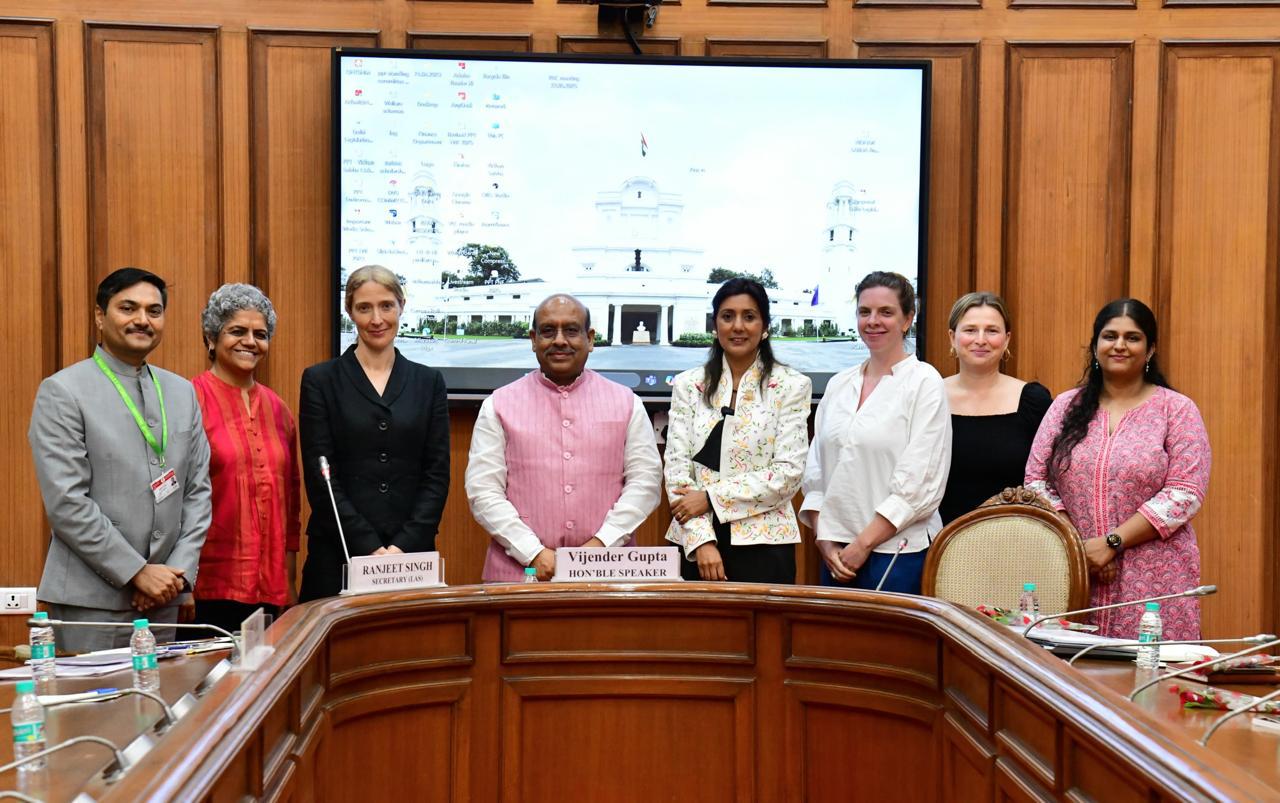
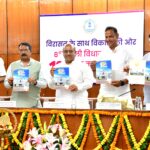
New Delhi: Our shared democratic values and historic ties continue to guide the evolving partnership between India and the United Kingdom,” stated Hon’ble Speaker Shri Vijender Gupta during a courtesy meeting with the visiting British Parliamentary Delegation, led by Her Excellency Mrs. Nusrat Ghani, Deputy Speaker of the UK House of Commons, at the Delhi Legislative Assembly.
The British Parliamentary Delegation was led by Her Excellency Nusrat Munir Ul-Ghani; Deputy Speaker of the House of Commons and comprised of several distinguished dignitaries and officials, including Sarah Davies, Clerk Assistant in the House of Commons; Abigail Samuels, Private Secretary to the Deputy Speaker; Natalia Leigh, Head of Political and Bilateral Affairs at the British High Commission in New Delhi; Alexandra Knowles, Deputy Head of Political and Bilateral Affairs at the British High Commission; Bhavna Vij, Senior Political and Economic Adviser; and Parul Kavia, Political Adviser.
During the interaction, Shri Gupta emphasised the strategic transformation of India-UK relations into a contemporary, multi-dimensional partnership shaped by frameworks such as the Comprehensive Economic and Trade Agreement (CETA) and the India-UK Vision 2035. “With our roadmap now expanded to cover trade, technology, education, defence, climate action, and innovation, we stand together as partners in global progress,” he remarked. He further underscored the valuable contributions of the Indian diaspora and Indian businesses in enhancing bilateral economic engagement.
Education featured prominently in the discussions. Shri Gupta noted that more than 170,000 Indian students are currently enrolled in UK universities. He warmly welcomed the initiative by UK universities to establish campuses in India—particularly the University of Southampton’s forthcoming campus in Gurugram—and praised the 2022 mutual recognition of academic qualifications as a pivotal development in academic mobility and cooperation.
Shri Gupta also apprised the delegation of the Delhi Assembly’s pioneering reforms. He highlighted the complete transition to a paperless legislative process through the National e-Vidhan Application (NeVA) and the commissioning of a 500 kW rooftop solar power plant. “We are proud to be India’s first Assembly to achieve net-zero carbon status—within just 100 days of the 8th Legislative Assembly,” he said.
Shri Gupta further informed the delegation about the ongoing restoration efforts of the Assembly’s historic premises—formerly the seat of the British Imperial Legislative Council—as a national heritage site. He earnestly requested the delegation’s assistance in facilitating access to valuable archival materials held by the British Council, stating, “We request that these records be made available at the earliest to support our efforts to document and preserve this institution’s legacy for future generations.”
In her remarks, Her Excellency Nusrat Ghani expressed deep appreciation for the hospitality extended by the Delhi Legislative Assembly and acknowledged both its historic legacy and its modern relevance. She commended the Assembly’s strides in embracing digital innovation and sustainability, describing it as a forward-looking model of 21st-century legislative governance. Emphasising the Delhi Assembly’s role as a beacon of progressive institutional reform, she reiterated the importance of legislatures in tackling global challenges and called for enhanced people-to-people engagement and stronger inter-parliamentary cooperation.
The meeting concluded with a reaffirmation of shared democratic values and a commitment to deeper institutional collaboration. It marked a meaningful step toward strengthening India-UK parliamentary ties, while highlighting the essential role of legislatures in advancing innovation, sustainability, and the preservation of democratic heritage.